
Automotive ECU Diagnostics with CAN FD and UDS from the Ground Up™
Master CAN FD and UDS by developing diagnostic firmware for automotive ECUs.
Watch Promo
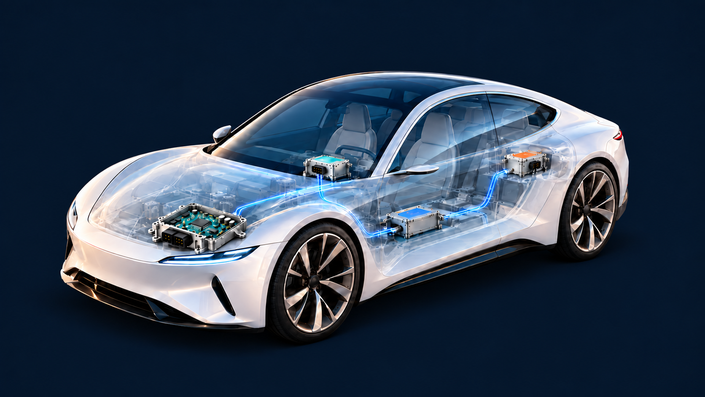
A single modern car can contain more than 100 Electronic Control Units (ECUs). These embedded computers manage functions throughout the vehicle, from braking and steering to powertrain and body electronics.
Software increasingly defines how these vehicles function and evolve. In 2025, BMW reported that its Neue Klasse development teams were working on more than 500 million lines of code for the vehicle’s electronic architecture, with software designed to keep evolving through updates.
Electrification is expanding this landscape. More than 20 million electric cars were sold worldwide in 2025, up 20% in one year and accounting for one in four new cars sold, according to the International Energy Agency.
For embedded firmware engineers, knowing how to communicate with ECUs is a core practical skill for the automotive sector. You need to access their data, investigate faults, run diagnostic tests, and verify their behavior.
Turn your embedded programming skills into a valuable automotive specialization. Develop practical expertise for ECU firmware, ECU testing, and diagnostic-tool development, with applications across passenger cars, electric vehicles, commercial vehicles, and off-highway machinery.
CAN FD and Unified Diagnostic Services (UDS) are key technologies behind this work.
Automotive ECU Diagnostics with CAN FD and UDS from the Ground Up™ takes you step by step through building and testing a working diagnostic ECU. You will develop firmware in C on STM32 hardware and verify it with a Python diagnostic tester.
You will implement the logic behind diagnostic requests: validate the request, check permissions, perform the operation, and return the appropriate response. You will learn to explain why requests succeed or fail, troubleshoot communication problems, and verify what the ECU actually did.
By the end of the course, you will be able to:
- Connect an ECU to a diagnostic tester using CAN FD.
- Implement ISO-TP transport with message segmentation, reassembly, flow control, sequencing, and timeout handling.
- Build a UDS server with diagnostic sessions, service permissions, response timing, and correct handling of accepted and rejected requests.
- Read and write ECU data through Data Identifiers (DIDs), with validation and access rules.
- Record, report, and clear simulated faults using Diagnostic Trouble Codes (DTCs), and execute diagnostic routines with defined results.
- Transfer a firmware image into reserved ECU flash, verify its integrity, and test transfer errors and recovery.
Build your automotive diagnostic expertise around a working ECU. Enroll and start developing with CAN FD and UDS.
Your Instructor
EmbeddedExpertIO represents a vibrant collective dedicated to the mastery of sophisticated embedded systems software development for professionals.
Our core objective is to equip individuals and organizations with the indispensable skills to thrive in the swiftly evolving embedded systems sector. We achieve this by providing immersive, hands-on education under the guidance of seasoned industry specialists. Our ambition is to emerge as the favored learning platform for embedded systems development professionals across the globe.
Course Curriculum
-
StartIntroduction to the Automotive Diagnostics Architecture Section (0:55)
-
StartDiagnostics Throughout ECU Development (1:26)
-
StartHow Diagnostics Support Calibration and Fault Investigation (1:20)
-
StartHow Diagnostics Support Updates and End-of-line Evidence (1:07)
-
StartThe Automotive Diagnostics Layers (3:36)
-
StartA Request Crossing the Stack (1:19)
-
StartDifferentiating Operational Signals from Diagnostics (2:20)
-
StartThe Tester Client and ECU Server (1:18)
-
StartWhy the Same Request Can Differ (1:19)
-
StartUnderstanding UDS and Legislated OBD (2:12)
-
StartThe Laboratory Hardware (1:39)
-
StartOverview of Our Capstone Project (1:58)
-
StartEssential Classical CAN Refresher (3:20)
-
StartWhy CAN FD Helps Diagnostics (1:57)
-
StartUnderstanding the CAN FD Frame Structure (2:05)
-
StartUnderstanding the Arbitration and Data Phase (1:37)
-
StartThe Data Length Code Mapping (1:46)
-
StartUnderstanding Bit Timing and Transceiver Delay (2:18)
-
StartThe STM32 FDCAN Architecture (2:36)
-
StartThe CAN Physical Network (1:02)