
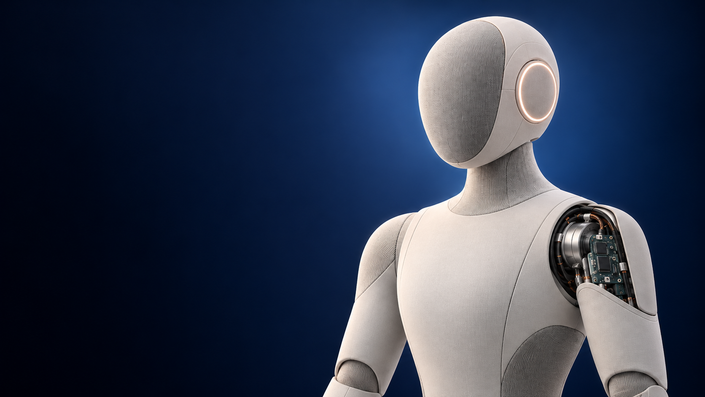
ROS 2 Software Development from the Ground Up™
Build the software foundation for modern robotics and the rise of physical AI.
Watch Promo
The AI revolution is moving into the physical world. Artificial intelligence is advancing beyond generating text, images, and code towards machines that can perceive their surroundings, make decisions, and perform physical tasks. This emerging frontier is known as Physical AI, and robotics is one of its most important applications.
The robotics industry is expanding at remarkable speed. According to the International Federation of Robotics, a record 5 million industrial robots were operating worldwide in 2025, with more than 600,000 new robots installed that year. Shipments of professional service robots grew by 24%, reaching nearly 250,000 units.
And the next wave is taking shape. Annual industrial robot installations are projected to reach 806,000 by 2029, while Goldman Sachs Research estimates that the global humanoid robot market could reach $38 billion by 2035.
For embedded engineers, this expansion presents an opportunity to become part of the next chapter of the AI revolution.
Modern robots depend on much more than intelligent algorithms. They require software systems that connect sensors, perception, decision-making, motion control, and diagnostics into a coordinated whole.
Engineers with experience in microcontrollers, firmware, communication interfaces, and embedded control already possess valuable foundations. Learning how to develop and integrate robotic software systems is a practical next step towards applying those skills in robotics and physical AI.
This is where ROS 2 comes in.
ROS 2, the Robot Operating System, is one of the world's most widely adopted open-source frameworks for robotic software development. It provides the communication infrastructure, interfaces, libraries, and engineering tools used to develop complex robotic applications.
Its adoption is substantial. According to Open Robotics, ROS 2 accounted for more than 91% of ROS package downloads in October 2025, while the wider ROS ecosystem includes more than 1,500 identified companies developing robotic products and services.
ROS 2 also has a direct connection to the emerging Physical AI ecosystem. NVIDIA Isaac ROS is built on ROS 2, bringing accelerated perception, AI capabilities, and deployment tools into robotic applications.
If you have ever considered entering the robotics industry, ROS 2 is an excellent place to begin.
ROS 2 Software Development from the Ground Up™ provides a structured foundation in modern robotic software engineering, starting from the very beginning. No previous ROS knowledge is required.
You will learn how robotic applications are organized, how independently developed components communicate, how tasks are coordinated, and how engineers configure, inspect, and debug distributed systems.
Through progressive practical lessons, you will move from creating your first ROS 2 node to developing an integrated, multi-node robotic application. You will implement communication interfaces, coordinate inspection missions, manage runtime configuration, handle interruptions, and investigate system faults.
By the end of the course, you will be able to:
- Develop ROS 2 applications, creating workspaces, packages, nodes, and reusable software components.
- Build distributed communication systems using publishers, subscribers, topics, and custom message interfaces.
- Implement services and actions for requests, long-running operations, progress feedback, results, and cancellation.
- Configure and launch multi-node applications using parameters, namespaces, remapping, and Quality of Service policies.
- Inspect, record, and debug robotic software using ROS 2 diagnostic tools, logging, and rosbag2.
- Integrate a complete multi-node robot software application, combining robot status, mission execution, runtime configuration, supervisory behaviour, and fault diagnosis.
Artificial intelligence is giving machines new capabilities. The engineers who understand how to connect those capabilities into working robotic systems will have an important role in what comes next.
Build your foundation in robotics and prepare for the expanding world of Physical AI. Enroll and start developing with ROS 2.
Frequently Asked Questions
Course Curriculum
-
StartNodes, Processes and the ROS Graph (1:57)
-
StartUnderstanding Names and Namespaces (1:08)
-
StartThe Discovery Process (1:48)
-
StartUnderstanding Topics, Publishers and Subscribers (1:52)
-
StartSome Good Examples For Using Topics (0:40)
-
StartUnderstanding Messages and Interfaces (2:45)
-
StartUnderstanding Services (1:50)
-
StartUnderstanding How Actions Model a Task Over Time (2:42)
-
StartUnderstanding How Parameters Configure Nodes (2:35)
-
StartChoosing the Correct ROS Interface (3:05)
Your Instructor
EmbeddedExpertIO represents a vibrant collective dedicated to the mastery of sophisticated embedded systems software development for professionals.
Our core objective is to equip individuals and organizations with the indispensable skills to thrive in the swiftly evolving embedded systems sector. We achieve this by providing immersive, hands-on education under the guidance of seasoned industry specialists. Our ambition is to emerge as the favored learning platform for embedded systems development professionals across the globe.