
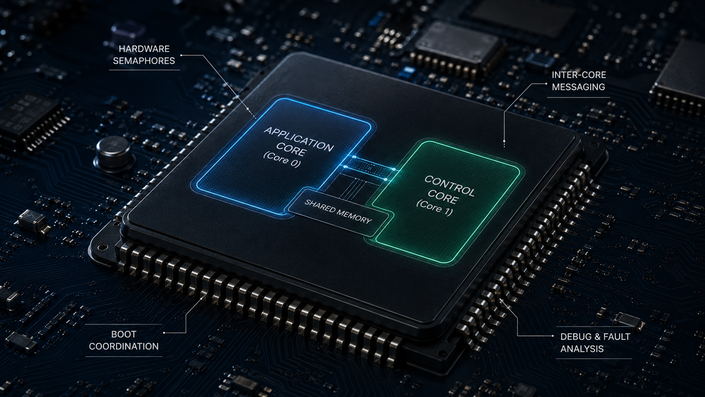
Advanced Multicore Bare-Metal Firmware Development: Engineering Inter-Core Systems
Build dual-core embedded firmware from the registers up using boot coordination, hardware semaphores, shared memory, custom inter-core messaging, and professional multicore debugging.
Watch Promo
Look at a device like the Apple Watch.
It is not just displaying time. It is sensing, processing, communicating, responding to touch, managing power, and supporting health-related features inside a tiny battery-powered product.
That kind of system cannot be understood as a simple firmware loop controlling a few peripherals.
Modern embedded products increasingly depend on partitioned compute.
But multicore firmware is not simply about adding another core. The real engineering challenge is learning how the cores cooperate.
Which core boots first? Which core owns system initialization? Which core owns a peripheral? How does one core safely notify the other? Where does shared data live? How do you prevent race conditions? How do you debug two processors without losing control of the system state?
This course is built around those questions.
In this advanced course, you will go below CubeMX, HAL, LL drivers, and generated initialization code. You will build a bare-metal multicore firmware system from the registers up, using direct register access, boot coordination, hardware semaphores, shared memory, custom inter-core messaging, and professional dual-core debugging.
This is not a course about pressing buttons in a configuration tool.
This is a course about engineering the relationship between cores.
You will start from a clean embedded project foundation and progressively build the mechanisms that make a real inter-core system work. You will bring up both cores, coordinate startup, configure low-level resources, use hardware semaphores for synchronization and notification, place shared data deliberately in memory, build a message-passing layer, and debug the complete system as a professional embedded firmware architecture.
By the end, you will understand multicore firmware at the level that matters when abstraction is no longer enough.
You will know how to reason about boot order, resource ownership, hardware signaling, shared memory, message flow, error handling, and the failure modes that appear when multiple cores must cooperate inside one embedded product.
Why Multicore Firmware Matters
As embedded products become more capable, firmware becomes harder to contain inside one simple control loop.
A single-core design may be enough when the product only reads a sensor, toggles an output, and sends occasional data. But when the same product must handle real-time control, communication, data processing, diagnostics, power management, updates, and fault recovery, the architecture becomes more demanding.
That is where multicore thinking becomes important.
One core may handle high-level application behavior. Another may handle timing-sensitive work. One core may supervise. Another may process data. One side of the system may produce information while another consumes it.
But this power introduces new failure modes.
If the cores start in the wrong order, the system may fail before the application begins. If shared memory is placed incorrectly, the cores may not see the same data. If hardware signaling is mishandled, one core may wait forever. If a peripheral has unclear ownership, both cores may interfere with each other. If cache or memory ordering is misunderstood, one core may read stale information and make the wrong decision.
That is why multicore firmware must be engineered deliberately.
What You Will Build
You will build a bare-metal dual-core firmware system where two embedded cores start correctly, coordinate execution, exchange structured data, signal each other through hardware mechanisms, and behave as one engineered system.
The project will include:
- direct-register peripheral configuration
- dual-core startup coordination
- hardware semaphore synchronization
- hardware semaphore interrupt notification
- linker-controlled shared memory placement
- shared data structures
- custom inter-core message passing
- request-response communication
- acknowledgement and timeout handling
- heartbeat and error-reporting behavior
- professional dual-core debugging and fault diagnosis
What Makes This Course Different
Many multicore examples show you how to use a vendor abstraction layer.
That is useful, but it is not enough.
When a multicore system fails, the real problem is often underneath the abstraction. One core may have started too early. A shared buffer may be in the wrong memory region. An interrupt may not have been cleared correctly. A semaphore may have been released incorrectly. A peripheral may have unclear ownership. One core may be reading stale data while the other believes it has already updated the system state.
This course is designed to expose those mechanisms directly.
You will not simply call a library function and trust that the system works. You will study what the system is doing, configure the relevant registers, observe the behavior, and build the inter-core architecture step by step.
The practical implementation uses a real dual-core STM32 development board, but the architectural lessons are broader than one board. The course uses a specific platform so that every mechanism can be implemented, tested, debugged, and explained with real firmware rather than abstract diagrams.
Who This Course Is For
This course is for embedded engineers and serious students who already understand the basics of microcontroller firmware and want to move into advanced multicore embedded development.
It is especially relevant if you have worked with STM32, bare-metal firmware, HAL-based projects, RTOS-based projects, bootloaders, communication interfaces, sensor systems, or performance-sensitive embedded applications, and now want to understand how professional dual-core and multicore systems are engineered below the abstraction layer.
This is not a beginner microcontroller course.
It is for developers who want to understand how multicore firmware really works.
What You Will Learn
You will learn how to think about multicore firmware as a system architecture problem.
You will learn how to divide responsibility between cores, coordinate boot flow, assign resources, protect shared data, use hardware synchronization, exchange messages, and debug multicore behavior.
You will also learn how bare-metal multicore development compares with higher-level approaches such as HAL-based development, middleware-based communication, and RTOS-based messaging.
The goal is not to reject abstraction.
The goal is to understand what abstraction is hiding so that you can design, debug, and reason like a professional firmware engineer.
Your Instructor

EmbeddedExpertIO represents a vibrant collective dedicated to the mastery of sophisticated embedded systems software development for professionals.
Our core objective is to equip individuals and organizations with the indispensable skills to thrive in the swiftly evolving embedded systems sector. We achieve this by providing immersive, hands-on education under the guidance of seasoned industry specialists. Our ambition is to emerge as the favored learning platform for embedded systems development professionals across the globe.