
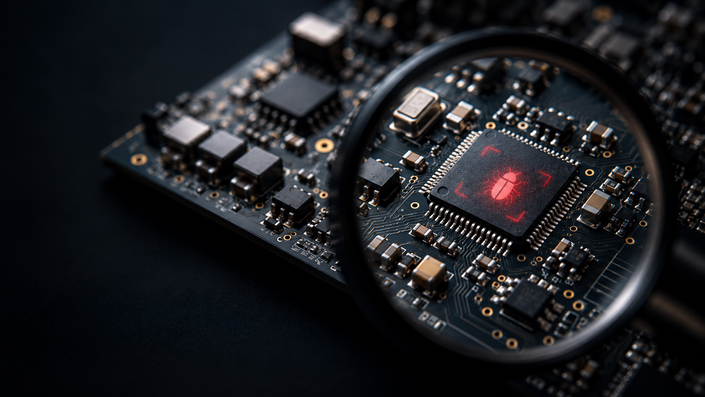
Professional Firmware Debugging and Fault Analysis from the Ground Up™
Working with STM32, an IDE, GDB, ST-LINK, and SWD, you will learn how to move beyond trial-and-error troubleshooting and develop the professional evidence-based approach to finding and fixing firmware defects.
Watch Promo
Look at embedded firmware engineering job postings. What skills keep appearing? Embedded C/C++ development. Firmware debugging and root-cause analysis. Python-based test automation.
These are professional skills employers actively look for. Apple's AirPods firmware team emphasizes debugging real-time systems with limited visibility. Axon's Firmware Engineer I role calls for systematic root-cause analysis. Anduril specifies JTAG/SWD debugging experience and Python scripting for test automation in its firmware engineering openings.
But professional firmware debugging goes far beyond setting breakpoints, stepping through code, or strategically inserting printf() statements to locate problems.
These are useful techniques, but they are not a complete debugging methodology. There is a systematic engineering approach to reproducing failures, gathering evidence, isolating faults, identifying root causes, implementing corrections, and verifying that the problems have actually been resolved.
Whether you are preparing for an embedded firmware engineering position or already working in the industry, this is a fundamental professional competence.
About This Course
Embedded Firmware Debugging and Fault Analysis from the Ground Up teaches you how to investigate complex firmware failures systematically, using the tools, techniques, and reasoning methods employed in professional embedded development.
Working with STM32, an IDE, GDB, ST-LINK, and SWD, you will learn how to move beyond trial-and-error troubleshooting and develop an evidence-based approach to finding and fixing firmware defects.
The emphasis is on investigating faulty firmware, understanding precisely why failures occur, and demonstrating that corrections work, rather than spending time rebuilding elementary peripheral drivers.
What You Will Learn
- Professional Debugging and Root-Cause Analysis: Fault reproduction, hypothesis-driven investigation, fault isolation, evidence collection, root-cause analysis (RCA), and systematic troubleshooting.
- Advanced Debugging Tools: GDB, SWD/JTAG, hardware and software breakpoints, conditional breakpoints, DWT watchpoints, FPB, memory and register inspection, disassembly, ELF files, linker maps, and debug-versus-release behaviour.
- HardFault and Exception Forensics: Cortex-M exception handling, HardFault, MemManage, BusFault, UsageFault, SCB fault-status registers, CFSR, HFSR, BFAR, MMFAR, EXC_RETURN, MSP/PSP, stacked register context, and faulting-instruction analysis.
- Memory Corruption and Stack Failures: Out-of-bounds accesses, invalid pointers, memory corruption, stack overflow, heap failures, object lifetime defects, and techniques for tracing corruption back to its original cause.
- Interrupts, Timing, and Peripheral Debugging: NVIC configuration, interrupt priorities, ISR failures, shared-variable race conditions, volatile, critical sections, DWT cycle counting, timing analysis, UART faults, buffer overruns, DMA failure modes, and debugger observer effects.
- Professional Testing and Fault Verification: Controlled fault injection, functional and boundary testing, negative testing, regression testing, verification of firmware corrections, and professional debugging reports.
Develop the Skills to Investigate Firmware Failures with Confidence
Designed for aspiring and practising embedded firmware engineers with a foundation in embedded C, this course develops the practical reasoning and technical skills needed to investigate challenging firmware problems with precision and professionalism.
Don't just learn how to use a debugger. Learn how to debug firmware professionally, establish the root cause of failures, and produce evidence that your corrections work.
Frequently Asked Questions
Your Instructor

EmbeddedExpertIO represents a vibrant collective dedicated to the mastery of sophisticated embedded systems software development for professionals.
Our core objective is to equip individuals and organizations with the indispensable skills to thrive in the swiftly evolving embedded systems sector. We achieve this by providing immersive, hands-on education under the guidance of seasoned industry specialists. Our ambition is to emerge as the favored learning platform for embedded systems development professionals across the globe.