
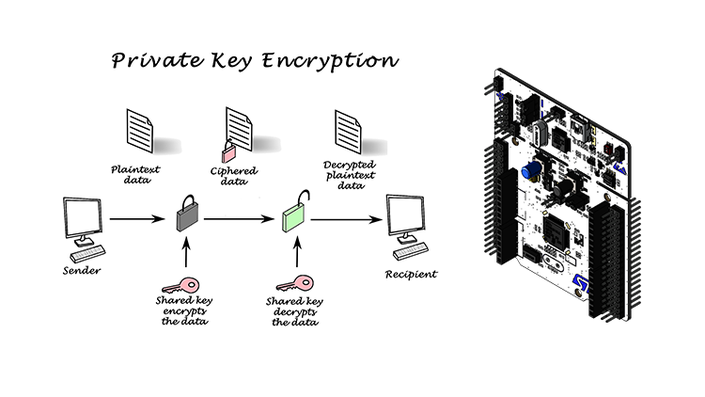
Implement real cryptography in embedded firmware with confidence.
Learn how to design, understand, and integrate practical cryptographic building blocks for ARM-based microcontrollers, including AES, SHA-256, HMAC, RSA, ECC, DRBG, and STM32 cryptographic middleware.
This is not a theory-only cryptography course.
It is a practical embedded systems training built for engineers who want to understand how modern cryptography is actually applied in firmware.
What you will learn:
- symmetric encryption with AES
- hashing with SHA-256
- message authentication with HMAC
- random number generation with DRBG
- public key foundations with RSA and ECC
- STM32 cryptographic library integration
- host-side Python tooling for validation and test workflows
If you build embedded systems that store data, communicate externally, receive updates, or interact with connected environments, this is a capability worth building now.
Why This Course Matters
Embedded security is no longer optional
Modern embedded products are expected to do more than function correctly. They are expected to protect data, resist tampering, support secure communication, and form part of a trustworthy system.
Yet many embedded engineers were never taught how cryptography is actually implemented at the firmware level.
They may know the terminology.
They may understand the high-level concepts.
But when it is time to work with encryption, hashing, authentication, randomness, or key-based security in a real embedded workflow, that confidence often disappears.
This course was created to close that gap.
You will move beyond abstract definitions and begin understanding how practical cryptography fits into embedded systems engineering.
What Makes This Training Different
Built for embedded engineers, not general software audiences
Most cryptography training is either too academic or too disconnected from firmware reality.
This course takes a different approach.
It focuses on the practical needs of embedded developers working with ARM microcontrollers and STM32-class devices. Instead of teaching cryptography as a purely mathematical subject, it teaches it as an engineering capability.
You will learn not only what the major cryptographic components are, but also how they are used, how they fit together, and how to reason about them inside a real embedded development context.
You will cover topics such as:
- why encryption matters in embedded products
- common embedded threat scenarios
- symmetric vs asymmetric cryptography
- practical cipher workflows
- padding and block handling
- secure digests and authentication
- deterministic random bit generation
- public key fundamentals
- embedded implementation flow using STM32 tools and libraries
- host-side verification using Python
What You Will Learn
By the end of this course, you will understand how to:
- explain the role of cryptography in embedded systems
- distinguish between encryption, hashing, authentication, and randomness
- implement and reason about AES-based workflows
- work with PKCS#7 padding correctly
- understand and apply SHA-256 and HMAC concepts
- use DRBG-based random generation principles
- understand the practical purpose of RSA and ECC in embedded environments
- integrate STM32 cryptographic software components into a firmware workflow
- validate key cryptographic behavior with supporting Python tools
- build stronger security awareness as an embedded firmware engineer
Course Curriculum Snapshot
A practical path from foundations to implementation
This training includes a structured progression through the key areas embedded engineers need in order to begin working confidently with cryptography.
Core areas include:
1. Security context and embedded threat awareness
Understand why cryptography matters, where embedded systems are vulnerable, and how security capabilities fit into modern product design.
2. Cryptographic foundations
Build a clean understanding of the major categories of cryptographic systems and when they are used.
3. Symmetric encryption workflows
Learn the principles behind practical encryption approaches including AES and common operating considerations.
4. Hashing and message authentication
Understand how SHA-256 and HMAC contribute to integrity and trust.
5. Randomness and key-related foundations
Study DRBG concepts and why randomness matters in cryptographic systems.
6. Public key cryptography
Develop a practical understanding of RSA and ECC in embedded use cases.
7. STM32 implementation and validation workflows
Work through firmware-oriented integration using STM32 cryptographic software and Python-based support tooling.
Who This Course Is For
This course is a strong fit for:
- embedded firmware engineers working with ARM-based microcontrollers
- STM32 developers who want practical security knowledge
- engineers building connected or updateable products
- developers moving into embedded security responsibilities
- technical professionals who want to understand cryptography beyond buzzwords
- students and early-career engineers who want stronger real-world embedded skills
This course is not designed for:
- people looking for a purely mathematical cryptography program
- learners who want only abstract theory without firmware context
- general software audiences with no interest in embedded systems
Why Learn This Now
The embedded engineer who understands security has an advantage
As products become more connected, more updateable, and more exposed to hostile environments, embedded teams increasingly need engineers who can think beyond drivers and peripherals.
They need engineers who understand trust, integrity, confidentiality, and secure system behavior.
That does not mean every engineer must become a cryptography specialist.
But it does mean that practical security literacy is becoming a more valuable capability.
This course helps you build that capability in a way that is grounded in embedded reality.
Learn from an embedded systems educator with real engineering depth
This training is taught by Israel Gbati, embedded systems educator, engineer, and founder of EmbeddedExpertIO.
Israel has taught embedded systems to engineers around the world and is known for practical, implementation-focused training that goes beyond theory and into real firmware workflows.
His teaching is built around one core principle:
Engineers should leave with skills they can actually apply.
That same philosophy shapes this course.
You will not just hear definitions.
You will build understanding that is usable in real embedded work.
Frequently Asked Questions
Your Instructor

EmbeddedExpertIO represents a vibrant collective dedicated to the mastery of sophisticated embedded systems software development for professionals.
Our core objective is to equip individuals and organizations with the indispensable skills to thrive in the swiftly evolving embedded systems sector. We achieve this by providing immersive, hands-on education under the guidance of seasoned industry specialists. Our ambition is to emerge as the favored learning platform for embedded systems development professionals across the globe.