
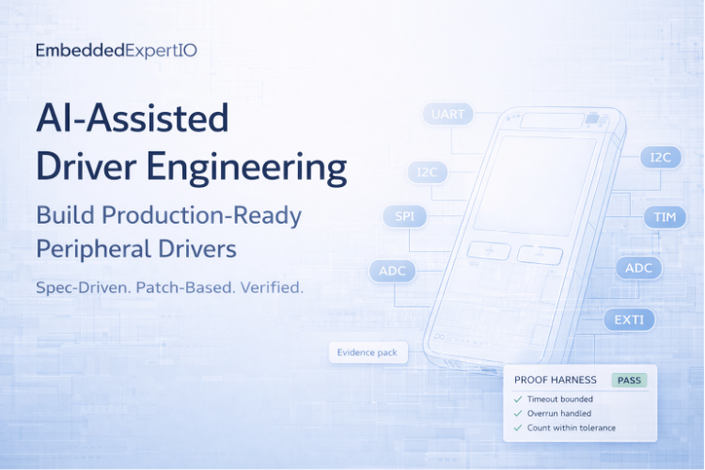
AI-Assisted Embedded Driver Engineering
Build Production-Ready Peripheral Drivers: Spec-Driven, Patch-Based, Verified
Watch Promo
AI-Assisted Embedded Driver Engineering
Build Production-Ready Peripheral Drivers: Spec-Driven, Patch-Based, Verified
Not code snippets. A professional driver workflow with interfaces, proof harnesses, and release-ready packaging.
Imagine this scenario...
You have been assigned to ship the firmware foundation for a new handheld device.
A portable measurement instrument is going into pilot deployments in four weeks.
It needs:
- ADC sampling for sensor inputs
- timers for sampling schedules, PWM, and capture
- SPI for a display or storage
- I2C for calibration and companion sensors
- UART for factory test, field diagnostics, and support tooling
- external interrupts for buttons, triggers, and event capture
Now here is the twist:
Your team wants the speed of AI assistance, but they will not accept AI-generated chaos.
Your lead says:
“We will use an AI assistant, but we are not shipping blobs. Every driver must match our coding style and conventions.
Every change must be reviewable as small diffs.
Every behavior must be proven on hardware.
And you are responsible for the evidence.”
That is exactly what this program trains you to do.
Because the new reality is simple:
AI is now part of firmware development. The engineers who win are the ones who can control it.
This is not a driver course
You already have driver courses. This is different.
This program is about using AI assistance in a way that produces drivers that are:
- consistent with a professional codebase
- consistent with a team’s API style and conventions
- implemented in safe, incremental patches
- verified with target proof, not wishful thinking
- packaged for release with documentation and evidence
If you have ever prompted an AI tool for “write an SPI driver” and got something that compiles but cannot be trusted, you already understand why this matters.
The Driver Pack includes multiple drivers built under the same standard, such as:
- GPIO (clean pin abstraction and atomic writes)
- UART (timeouts, error flags, then interrupt-driven RX)
- I2C and SPI foundations with real failure handling patterns
- Timers (timebase, PWM, capture, update interrupts)
- ADC foundations with timing awareness and validation
- DMA
The important part is not the list.
The important part is the workflow you use to build and verify them.
The workflow that makes AI safe and useful
Most people use AI like this:
“Write me a driver.”
They get a blob. It is not consistent with their codebase. It is not reviewable. It has no proof. It breaks later.
In this program, you use AI like a disciplined firmware team:
1. Define scope and success conditions
2. Extract constraints that actually matter
(timing, blocking, interrupts, error handling)
3. Lock the interface contract and invariants
4. Use a risk checklist and verification plan before writing code
5. Have the AI assistant propose one small API addition at a time
6. Approve the contract, then generate a minimal implementation patch
7. Run proof on target with measurable pass criteria
8. Harden for real failure modes
9. Package for release: docs, examples, known issues, evidence pack
This is how you get AI speed without quality collapse.
Why this makes you faster without lowering standards
You are not learning how to “prompt better”.
You are learning how to:
- turn AI into a supervised co-developer
- force consistent style and conventions through a reference codebase
- prevent rewrites and hallucinated APIs with patch discipline
- ship drivers with evidence that a lead engineer can trust
This is the difference between “AI produced code” and “AI-accelerated engineering”.
What you will be able to do after this program
You will be able to take a new peripheral and repeatedly ship a driver that is:
- Spec-driven: requirements and invariants first
- Patch-based: reviewable diffs only, no rewrites
- Verified: target proof harness with pass and fail criteria
- Release-ready: documentation, examples, and evidence artifacts
You will stop shipping “it works on my desk” drivers.
You will ship drivers you can defend.
Who this is for
This is for embedded engineers who:
- want to use AI assistance without creating unmaintainable code
- already know drivers matter, but want a repeatable professional method
- want a workflow that produces trust, not just output
This is not for anyone looking for quick copy-paste snippets.
Why now
AI-assisted firmware engineering is becoming faster, but also riskier.
In the next few years, the engineers who stand out will not be the ones who can generate code.
They will be the ones who can:
- control AI output
- enforce contracts and style
- verify on hardware
- ship with evidence
That is what this program gives you.
Enroll now and learn the professional workflow for building production-ready peripheral drivers with AI assistance, proof, and release discipline.
Frequently Asked Questions
Your Instructor

EmbeddedExpertIO represents a vibrant collective dedicated to the mastery of sophisticated embedded systems software development for professionals.
Our core objective is to equip individuals and organizations with the indispensable skills to thrive in the swiftly evolving embedded systems sector. We achieve this by providing immersive, hands-on education under the guidance of seasoned industry specialists. Our ambition is to emerge as the favored learning platform for embedded systems development professionals across the globe.